


Container Door Markings: A Complete A–Z Guide to Their Meanings
When working in logistics, import-export, or international transportation, you are probably familiar with the series of letters and numbers prominently displayed on container doors. However, not everyone fully understands the meaning behind these markings.
Understanding how to read container markings not only helps businesses accurately verify cargo and minimize errors on shipping documents such as the Bill of Lading, but also plays a critical role in ensuring safety during loading, unloading, and transportation.
Songwin will help you decode all the important markings found on container doors according to international standards.
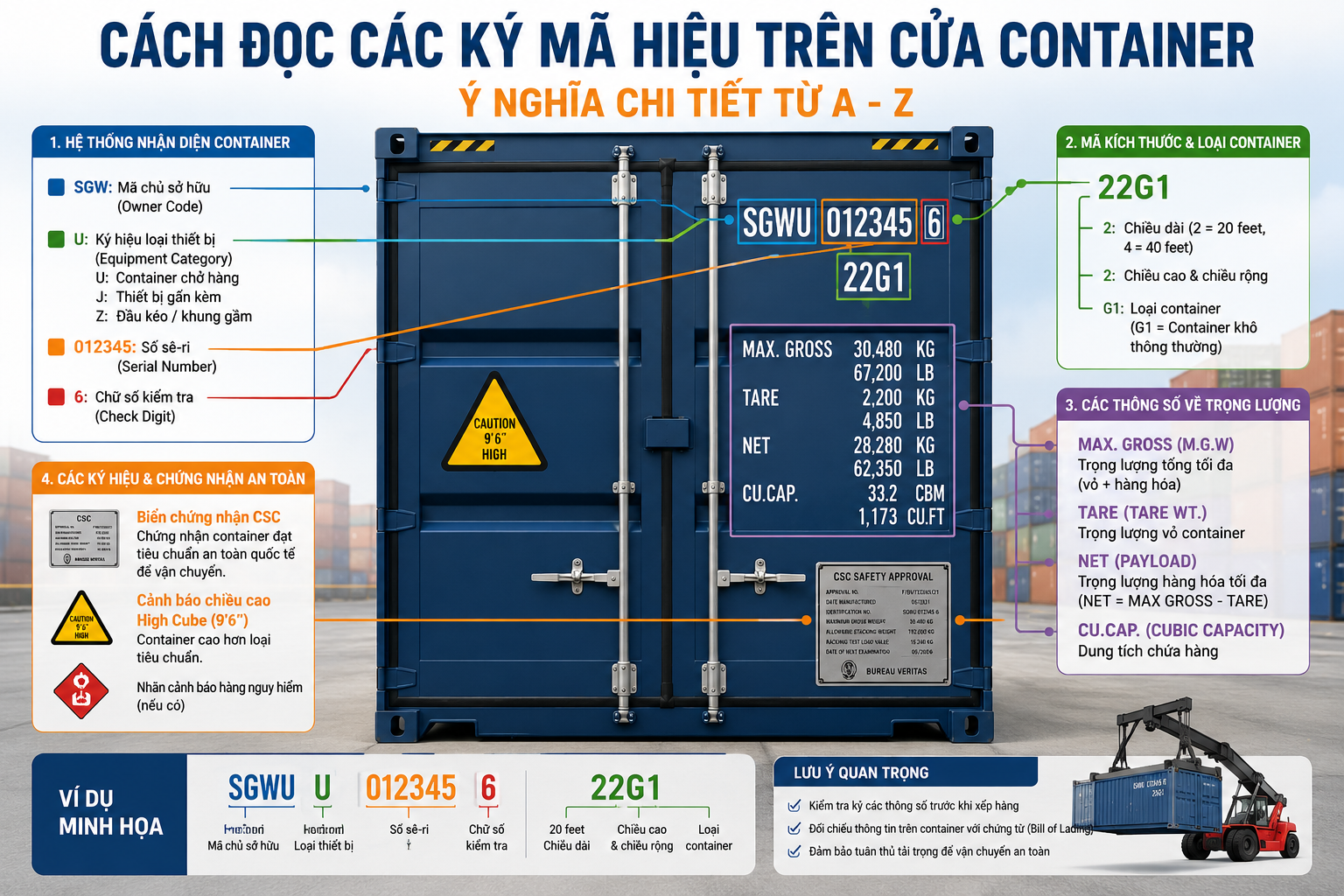
1. Container Identification System
This is the most important group of markings on a container, usually located at the upper right corner of the container door. The system follows the international ISO 6346 standard and consists of four main components:
Owner Code (BIC Code / Owner Code)
- Consists of the first three uppercase letters.
- Represents the company that owns or operates the container.
- These codes must be registered with the Bureau International des Containers (BIC).
Example:
- SGW may be the registered code of Songwin.
Equipment Category Identifier
This is the letter immediately following the owner code.
Meaning of each identifier:
- U: Freight container (the most common type)
- J: Detachable container-related equipment
- Z: Trailer or chassis
Container Serial Number
- Consists of 6 digits.
- Serves as the unique identification number of the container.
- Assigned by the container owner.
If fewer than 6 digits are used, leading zeros will automatically be added.
Example:
- 012345
Check Digit
- The final single digit, usually displayed inside a box.
- Used to verify the accuracy of the entire container number through computer systems or management software.
Practical Example
A container door displays:
SGWU 012345 [6]
Meaning:
- SGW → Container owner code
- U → Freight container
- 012345 → Container serial number
- [6] → Check digit
2. Container Size and Type Codes
Below the container number, you will often see a 4-character code such as:
- 22G1
- 45R1
- 42U1
These codes identify the container’s dimensions and technical specifications.
First Two Characters – Size Code
- The first digit indicates container length:
- 2 = 20-foot container
- 4 = 40-foot container
- The second digit represents container height and width.
Last Two Characters – Type Code
Some common codes include:
| Code | Container Type | Meaning |
|---|---|---|
| G1 | General Purpose | Standard dry container |
| R1 | Refrigerated | Reefer container |
| U1 | Open Top | Open-top container |
| P1 | Platform | Platform container |
| T1 | Tank Container | Tank container |
3. Weight Specifications (Weight Panel)
This group of information is extremely important for:
- Shipping lines
- Warehouse operators
- Container truck drivers
- Cargo handling companies
These specifications help calculate safe loading limits during transportation.
| Marking | Full Name | Meaning |
|---|---|---|
| MAX. GROSS or M.G.W | Maximum Gross Weight | Maximum allowable total weight of the container and cargo |
| TARE or TARE WT. | Tare Weight | Weight of the empty container |
| NET or PAYLOAD | Net Cargo Weight | Maximum allowable cargo weight |
| CU.CAP. | Cubic Capacity | Internal cargo volume capacity |
Important Formula
The maximum cargo weight is calculated using the following formula:
NET=MAX GROSS−TARENET = MAX\ GROSS - TARENET=MAX GROSS−TARE
Where:
- NET: Maximum cargo weight
- MAX GROSS: Maximum allowable gross weight
- TARE: Empty container weight
4. Other Safety Markings and Certifications
In addition to the main technical specifications, container doors also display several important labels and certification plates.
CSC Safety Approval Plate
This is a metal plate permanently attached to the container to certify that it meets international safety standards for cross-border transportation.
Information on the CSC plate typically includes:
- Year of manufacture
- Registration number
- Permitted load capacity
- Inspection date
Special Warning Labels
Some containers may also display:
- Yellow-black stripes: Warning for High Cube containers (taller than standard containers)
- Dangerous goods labels: Used for containers carrying chemicals, flammable substances, explosives, or hazardous cargo
These markings help operators handle containers according to proper safety procedures.
Why Businesses Need to Understand Container Markings
Understanding container markings helps businesses:
- Accurately verify containers against shipping documents
- Reduce transportation errors
- Ensure load safety
- Optimize logistics and warehouse operations
- Avoid mistakes during customs declaration or vessel booking
SONGWIN INTERNATIONAL LOGISTICS VIETNAM CO., LTD
📍 Address: 344 Nguyen Trong Tuyen Street, Tan Son Hoa Ward, Ho Chi Minh City, Vietnam
📞 24/7 Hotline: 083.681.3969 – 0373.262.105
📧 Email: Sales2@songwinlog.com
Songwin Logistics – Reputation Builds the Brand, Professionalism Creates Success.


![[Detailed Guide] Procedure for Obtaining a Certificate of Eligibility for Conditional Chemical Trading](https://www.songwinlog.net/thumbs/355x266x1/upload/news/bai-dang-instagram-thong-bao-lich-nghi-tet-2026-cao-cap-toi-gian-do-vang-1-3608.png)